
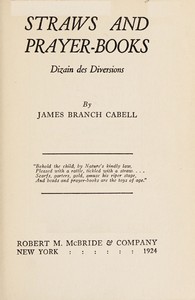
Straws and prayer-books; dizain des diversions by James Branch Cabell
James Branch Cabell is one of those authors you stumble upon in the dusty back corner of a used bookstore. Reading 'Straws and Prayer-Books' is like opening a beautifully crafted music box only to find a tiny, satirical play going on inside. It's not a novel in the usual sense, but a series of ten-line vignettes, or 'dizains,' each a self-contained world of irony and wit.
The Story
There isn't one linear plot. Instead, Cabell builds a mood. He takes us to a fictional medieval province called Poictesme, a land of chivalry, romance, and profound absurdity. In these tiny stories, we meet knights on quests for honor that turns out to be hollow, lovers pursuing beauties who are ultimately unattainable, and philosophers debating truths that might not exist. Each dizain is a perfect little bubble of story—a man chooses a straw to decide his fate, a woman prays for a love that's already left—and then Cabell pops it, leaving you with the echo of a question rather than an answer. It’s less about what happens next and more about the poignant, often funny, space between what people wish for and what they actually get.
Why You Should Read It
I loved this book for its voice. Cabell writes with a twinkle in his eye. He’s never mean, but he’s always honest about our human follies. His characters are so earnest in their pursuits, whether it's glory or love, and he shows how that earnestness is both beautiful and a little ridiculous. The theme is right there in the title: we grasp at 'straws' (fleeting pleasures, chance) and 'prayer-books' (solemn duty, faith) looking for something to hold onto. Reading it feels refreshingly adult—it assumes you're smart enough to get the joke and feel the melancholy underneath. It’s a masterclass in saying a lot with very little.
Final Verdict
This book isn't for everyone. If you need fast-paced action and clear-cut heroes, look elsewhere. But if you're a reader who enjoys clever prose, philosophical musings served with a side of smirk, and the unique charm of early 20th-century fantasy that’s more about poking fun at myths than building them, you’ll find a gem here. It’s perfect for fans of writers like Oscar Wilde or Lord Dunsany, or anyone who likes their fairy tales with a sharp, satirical edge. Think of it as a short, potent cocktail of ideas—sip it slowly.
The copyright for this book has expired, making it public property. You are welcome to share this with anyone.
Kimberly Sanchez
2 years agoAfter hearing about this author multiple times, the narrative structure is incredibly compelling. One of the best books I've read this year.
Deborah Gonzalez
1 year agoI didn't expect much, but the storytelling feels authentic and emotionally grounded. Exactly what I needed.
Emily King
1 year agoFive stars!
Ethan Gonzalez
1 year agoRead this on my tablet, looks great.

Jennifer Williams
1 year agoMy first impression was quite positive because the author clearly has a deep mastery of the subject matter. If you want to master this topic, start right here.