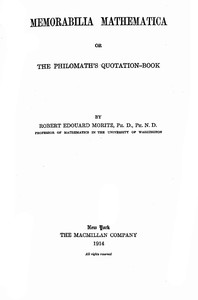
eBooks
35 Books foundWelcome to the ECAZU Public Domain Literature Library
The ECAZU archive offers a carefully assembled collection of public-domain works, drawn from Project Gutenberg and other reliable sources, focusing on mathematics, geometry, and their historical and cultural contexts. With 35 titles across four categories, the library provides a unique entry point for readers interested in the development of numerical thinking, geometric reasoning, and the broader intellectual currents that shaped them.
Browsing the Catalogue
Readers may explore the collection by category or browse individual book records. Each book is presented with a descriptive essay rather than a standard summary, offering context and thematic connections. The categories—Arithmetic; Geometry; and Applied Mathematics—serve as navigational guides rather than rigid classifications. Additionally, the editorial standards page details the principles behind the selection and presentation.
Understanding Book Records
Every book record includes the title, author(s), a concise catalogue note, keywords, and targeted reader description. The catalogue note provides editorial commentary intended to help readers decide whether a work aligns with their interests. Authors are credited as listed in the source text, including contributors such as editors and illustrators. Publication facts are taken from the source edition, typically from Project Gutenberg, and are noted where relevant.
Source Attribution
All works are sourced from Project Gutenberg, a trusted repository of public-domain texts. Each book includes a direct link to its Project Gutenberg page for verification. The ECAZU library does not host the full texts but provides editorial material and contextual guidance. the catalogue project, oversees the selection and quality of the catalogue.
Practical Reading Paths
For readers new to the collection, three paths may prove useful. Path One: Historical Foundations begins with The Earliest Arithmetics in English (category 1) and moves to The Hindu-Arabic Numerals (category 4) and The Number Concept (category 4), tracing the evolution of numerical systems. Path Two: Geometric Reasoning starts with The First Six Books of the Elements of Euclid (category 3), then explores The Way To Geometry (category 3) and An Essay on the Foundations of Geometry (category 3) for philosophical depth. Path Three: Play and Puzzles offers a lighter entry, beginning with Comic Arithmetic (category 1), moving to Amusements in Mathematics (category 4), and finishing with A Tangled Tale (category 4). Each path highlights connections across categories and periods.
Exploring Further
The catalogue is designed to encourage exploration beyond a single category. Readers are invited to use the category pages as starting points and to follow references to related works. The editorial standards page provides full disclosure of the library’s practices. For questions or suggestions, contact the catalogue project via the contact page. The about page offers additional background on the project.
Bibliographic dates and catalogue measurements
The catalogue distinguishes the Project Gutenberg digital release from a work’s original or first publication. Project Gutenberg is identified as the digital source for the edition available here; its release year is therefore shown as Gutenberg Release Year, not as the work’s original publication year.
When an explicit first-publication or issue date can be supported directly by the title or issue information, it may be shown separately as First Publication Year. When that date cannot be confirmed, the catalogue displays Not confirmed rather than guessing a year.
Where the source text can be measured reliably, the catalogue may provide word count and estimated reading time. These measurements describe reading scope and are not quality rankings.
The current catalogue contains 4 active subject categories: Arithmetic, Algebra, Geometry, and Applied Mathematics. Categories are browsing aids and may overlap where a work reasonably fits more than one subject.
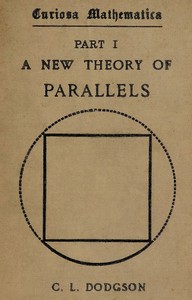

- Featured
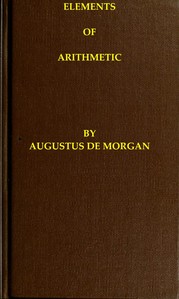
- Featured
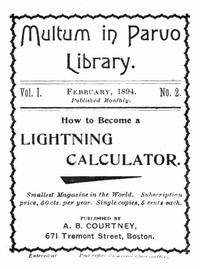
- Featured