
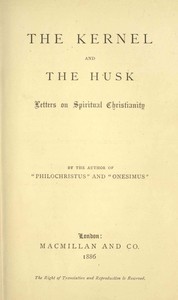
The Kernel and the Husk: Letters on Spiritual Christianity by Edwin Abbott Abbott
Don't let the old-fashioned title fool you—this book is a quiet earthquake. Published in 1886, it's structured as a series of letters from a man named 'E.' to his friend 'M.', who is struggling with doubt. Through these letters, Abbott (yes, the same guy who wrote the mathematical fantasy Flatland) takes apart traditional Christian beliefs with the care of a scholar and the heart of a believer.
The Story
There's no plot in the novel sense. The 'story' is the intellectual and spiritual journey. 'E.' guides his friend through the biggest questions: Are the miracles in the Bible meant to be read as historical fact? What if Jesus's resurrection was a spiritual truth, not a physical one? Abbott argues that clinging to ancient, pre-scientific explanations (the 'husk') risks destroying the profound ethical and spiritual core (the 'kernel') of Christianity. He suggests that faith should evolve with human understanding, and that letting go of literal interpretations doesn't mean letting go of God.
Why You Should Read It
I picked this up expecting a dusty theological debate. What I found was a voice of startling reason and compassion. Abbott isn't an angry critic; he's a loving insider trying to fix his own house. His writing is clear, patient, and surprisingly gentle. The most powerful parts are where he defends this new, 'spiritual' Christianity as more demanding, not less—it asks for a living faith in your daily actions, not just assent to ancient stories. Reading it, you feel the weight of his dilemma: he wants to be intellectually honest without sacrificing the community and meaning his faith provides. It's a balancing act many of us still recognize.
Final Verdict
This book is a hidden gem for thinkers, questioners, and anyone interested in the history of ideas. It's perfect if you've ever felt tension between modern knowledge and religious tradition. You don't have to be Christian to appreciate it; it's a masterclass in how people rebuild their worldview when old foundations crack. Fair warning: it's from the 1880s, so some references are dated, and his pace is thoughtful, not fast. But if you're curious about the roots of modern liberal theology, or just love seeing a sharp mind tackle life's biggest puzzles, give it a try. It's like having a profound conversation with a very wise, slightly worried, Victorian friend.
This content is free to share and distribute. Enjoy reading and sharing without restrictions.
Margaret Martinez
4 months agoThought-provoking and well-organized content.
George Lopez
1 year agoGreat value and very well written.
Nancy Thompson
5 months agoBefore I started my latest project, I read this and the way the author breaks down the core concepts is remarkably clear. Top-tier content that deserves more recognition.
Margaret Jones
2 months agoWhile browsing through various academic sources, the transition between theoretical knowledge and practical application is seamless. It definitely lives up to the reputation of the publisher.




Elizabeth Hernandez
8 months agoExactly what I was looking for, thanks!