
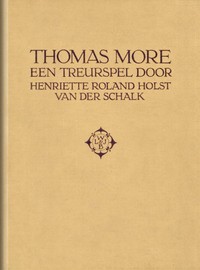
Thomas More: Een treurspel in verzen by Henriette Roland Holst-Van der Schalk
Henriette Roland Holst, a major figure in Dutch literature and socialism, uses verse drama to breathe new life into a familiar historical figure. Written in the early 20th century, her play feels both classical and quietly radical, focusing on the psychological weight of More's choice.
The Story
The play follows the final years of Sir Thomas More's life. King Henry VIII, desperate to secure a male heir, seeks to annul his marriage to Catherine of Aragon and marry Anne Boleyn. When the Pope refuses, Henry breaks with Rome, declares himself head of the Church of England, and demands all his subjects swear an oath to the new Act of Succession. More, the King's former friend and trusted Chancellor, finds himself in an impossible position. He cannot in good conscience approve of Henry's actions, but publicly opposing the king means treason. The story unfolds as More tries to remain silent, a strategy that only increases the pressure from the king and his ruthless advisors, like Thomas Cromwell. We watch as More is isolated from friends, imprisoned in the Tower of London, and finally brought to trial, where his brilliant legal mind and steadfast faith meet their ultimate test.
Why You Should Read It
What grabbed me wasn't the history, but the human portrait Holst paints. This More isn't just a saintly statue; he's a man torn between his duty to family, his loyalty to a friend-turned-tyrant, and his unshakable inner truth. The verse format is key—it's not flowery or difficult. Instead, it sharpens the dialogue, turning political arguments into poetic duels and private doubts into haunting soliloquies. You feel the claustrophobia of his situation. Holst also gives surprising space to the women in his life, especially his daughter Margaret, whose grief and strength add a powerful emotional layer. It makes the famous ending not just a historical footnote, but a devastating personal tragedy.
Final Verdict
This is a perfect pick for readers who love character-driven dramas and don't mind a story where the tension comes from moral debate rather than physical action. It's ideal if you enjoyed the philosophical struggle in plays like 'A Man for All Seasons' but want to experience a more lyrical, interior version. History buffs will appreciate the nuanced take, but you don't need to be one—Holst makes the central dilemma of conscience vs. power feel timeless. Just be ready for a thoughtful, emotionally rich, and ultimately heartbreaking read that sticks with you.
No rights are reserved for this publication. Use this text in your own projects freely.
Nancy Garcia
1 year agoI decided to give this a try based on a colleague's recommendation, the historical context mentioned in the early chapters is quite enlightening. A refreshing and intellectually stimulating read.
Jessica Perez
1 year agoFast paced, good book.
Dorothy Clark
6 months agoEnjoyed every page.
Emma Lee
5 months agoAs someone who reads a lot, the narrative structure is incredibly compelling. I will read more from this author.




Richard Lopez
8 months agoThis work demonstrates a clear mastery of contemporary theories.