About 673 minutes
Amusements in Mathematics — Edition Insights
Algebra · Applied Mathematics
154,756 recorded words. 107 minutes difference from this book's estimate.
View Gutenberg source #16713
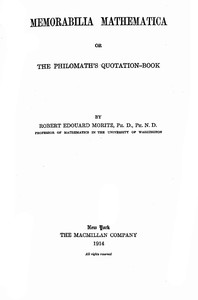
The catalog record for Memorabilia Mathematica; or, the Philomath's Quotation-Book — Story, Setting & Ideas provides practical reading context through 129,959 words, 9 hr 26 min estimated reading time, and 17 detected text sections.
The text analysis averages about 16.2 words per sentence, while the detected sections provide another way to judge how the source is divided.
Project Gutenberg metadata also associates the work with “Mathematics,” connecting these edition facts with the source record’s subject description.
Explore this collection
These alternatives are selected using recorded categories and estimated reading time.
About 673 minutes
Algebra · Applied Mathematics
154,756 recorded words. 107 minutes difference from this book's estimate.
View Gutenberg source #16713About 318 minutes
Applied Mathematics
73,003 recorded words. 248 minutes difference from this book's estimate.
View Gutenberg source #41654About 225 minutes
Arithmetic · Applied Mathematics
51,581 recorded words. 341 minutes difference from this book's estimate.
View Gutenberg source #22599Search stored excerpts and compare books → Choose by your preferences →
Choices use stored catalog measurements. Estimates vary with reading speed. A shared category is a catalog label, not a claim that two books have the same argument or literary quality.
Search reads excerpt text stored with this catalog and links to its associated Gutenberg record. The connection is stored in the site database; this tool does not recheck that every excerpt is word-for-word identical to that external record. Excerpt search does not cover every chapter and does not verify historical publication dates.
Catalog snapshot checked: 2026-09-26. Coverage: 35 public books, 31 available source excerpts.
Calculated from edition completeness, EPUB availability, text structure and catalogue metadata. Not a user rating.
Total of 100 points, scaled to a 2.5-5.0 range. Editions with an empty description or a missing EPUB file are not scored.
Public-domain source text
The source text is kept in the dedicated reader, separate from this catalogue record and its commentary.
Moritz opens his preface by noting that while many know Plato's phrase 'God geometrizes,' few can locate the exact passage. This practical frustration—spending 'hours and even days' hunting for precise statements—drove him to compile over a thousand quotations from more than three hundred authors, each with exact references. The book is organized under twenty thematic heads and cross-indexed under nearly seven hundred topics, making it a reference tool rather than a continuous narrative.
The preface reveals that Moritz devoted ten years to this collection, a span he describes as 'pleasurably employed.' He originally planned to include foreign quotations in both original and translation, but abandoned that as the material grew. The final work presents translations only, serving 'the best interest of the greater number of English readers.' This editorial decision shapes the book's accessibility: readers encounter a uniform language, though the original sources span multiple tongues.
Moritz groups quotations under twenty heads, though the excerpts show only two chapter titles: 'Mathematics and Philosophy' (Chapter XIV) and a section on logic. The cross-index under 'nearly seven hundred topics' allows a reader to trace a concept—say, 'logic'—across authors. For instance, entries 1324–1326 link John Fiske, Auguste Comte, and C. J. Keyser on mathematics as logical training. This structure rewards browsing: a single topic can reveal contrasting views from different eras.
The excerpts sample authors active around 1900: E. Schröder (1898), John Fiske (1893), Auguste Comte (1875 translation), C. J. Keyser (1912), J. F. Herbart (1890), and Kant. Moritz includes both mathematicians and non-mathematicians, as promised in the preface. Keyser's praise of Whitehead and Russell's Principia Mathematica as 'by far the greatest logic that our planet has produced' shows the compiler's willingness to include contemporary judgments. The quotations range from technical definitions to broad cultural claims.
The provided excerpts cover only the preface and a handful of entries from later chapters. The full book's 129,959 words span 17 text sections, but we cannot see the distribution of quotations across the twenty heads, nor the proportion of mathematicians versus poets. Moritz claims the book is accessible to 'the layman' because no technical processes are required, yet the excerpts include references to 'symbolic conceptions' and 'abstract relations.' A first-time reader should expect a dense reference work, not a narrative, and may need to sample multiple headings to gauge its range.
Approach Memorabilia Mathematica as a quarry, not a monograph. The preface is essential for understanding Moritz's aims and limitations—especially his decision to omit original-language quotations. When reading a section, note the date and source of each quotation; the book's value lies in its precise references, which allow you to verify and contextualize each passage. The cross-index is your best entry point for tracing a specific idea across centuries of thought.
That rainy afternoon, I kept returning to the Philomath’s quotation-book, savoring how Euler’s words brushed against Hardy’s quiet doubt. Eventually, the margins led me elsewhere, to numbers that hum beneath constants so familiar yet unnameable—a gentler, stranger country. Miscellaneous Mathematical Constants — Themes and Context felt less like a next step, more like a footpath already worn in part by my own pausing.
A brief reflection can help important ideas stay with you longer.

![Cover of Catalan's Constant [Ramanujan's Formula] — Text and Context](https://ecazu.com/storage/media/covers/pg682.jpg)