About 80 minutes
Mathematical Problems — Reading Companion
Geometry · Applied Mathematics
18,348 recorded words. 6 minutes difference from this book's estimate.
View Gutenberg source #71655
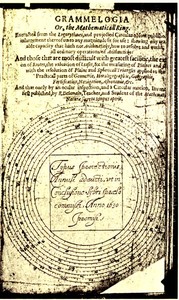
On the History of Gunter's Scale and the Slide Rule During the Seventeenth Century — Themes and Context can be approached with a clearer sense of reading commitment from its source measurements: 17,019 words, 1 hr 14 min estimated reading time, and 3 detected text sections.
The text analysis averages about 20.2 words per sentence, while the detected sections provide another way to judge how the source is divided.
Project Gutenberg metadata also associates the work with “Slide-rule,” connecting these edition facts with the source record’s subject description.
Explore this collection
These alternatives are selected using recorded categories and estimated reading time.
About 80 minutes
Geometry · Applied Mathematics
18,348 recorded words. 6 minutes difference from this book's estimate.
View Gutenberg source #71655About 89 minutes
Geometry · Applied Mathematics
20,434 recorded words. 15 minutes difference from this book's estimate.
View Gutenberg source #35550About 41 minutes
Arithmetic · Applied Mathematics
9,348 recorded words. 33 minutes difference from this book's estimate.
View Gutenberg source #254Search stored excerpts and compare books → Choose by your preferences →
Choices use stored catalog measurements. Estimates vary with reading speed. A shared category is a catalog label, not a claim that two books have the same argument or literary quality.
Search reads excerpt text stored with this catalog and links to its associated Gutenberg record. The connection is stored in the site database; this tool does not recheck that every excerpt is word-for-word identical to that external record. Excerpt search does not cover every chapter and does not verify historical publication dates.
Catalog snapshot checked: 2026-09-26. Coverage: 35 public books, 31 available source excerpts.
Calculated from edition completeness, EPUB availability, text structure and catalogue metadata. Not a user rating.
Total of 100 points, scaled to a 2.5-5.0 range. Editions with an empty description or a missing EPUB file are not scored.
Public-domain source text
The source text is kept in the dedicated reader, separate from this catalogue record and its commentary.
Florian Cajori opens this 1920 monograph by declaring that William Oughtred, not Edmund Wingate, invented the slide rule, and that Oughtred's circular rule was described in print in 1632, his rectilinear rule in 1633. He immediately introduces Richard Delamain as someone who 'tried to appropriate the invention to himself' and wrote a 'scurrilous pamphlet' against Oughtred. Cajori notes that earlier accounts relied on De Morgan, who had not read Delamain's own writings. The article promises to detail changes to Gunter's scale by several figures, examine Delamain's 1630 book, and recount the controversy between Oughtred and Delamain.
Cajori begins with Anthony Wood's account of Edmund Wingate transporting Gunter's 'rule of proportion' to France in 1624. He then traces modifications by Milbourn, Thomas Brown, John Brown, and William Leybourn. The text notes practical difficulties with the tangent line: when one arc was in the former mediety of the quadrant and the other in the latter, either one ruler had to be twice as long as the other, or an inversion and regression were required. This mechanical problem prompted Oughtred to consider inflecting the lines into two circles, doubling the tangents, and using a small thread in the center to direct the sight. Cajori presents these changes as incremental refinements driven by users' needs.
Cajori describes Delamain's 1630 book, which antedates Oughtred's first publication. He notes that Delamain's instrument of 1630 is described, along with later designs and directions for use. The text emphasizes that Delamain's writings were available through Dr. Arthur Hutchinson of Pembroke College, Cambridge, and that Cajori is the first to consult them directly. Delamain claimed to have sent Oughtred a sight of his projection drawn in pasteboard after their meeting. Cajori presents Delamain's account without endorsing it, letting the reader weigh the conflicting statements.
Cajori presents the dispute in parallel columns, quoting both men. Delamain's version: walking on Fishstreet hill before Christmas 1630, Oughtred said he had an invention that 'in a lesse extent of the Compasses shall worke truer then that of Mr. Gunters Ruler.' Oughtred claimed it was circular; Delamain said he immediately replied he had the like himself. Oughtred's version: he told Delamain of his instrument with logarithms projected into circles, less than one foot in diameter, performing as much as a six-foot Gunter's ruler. Oughtred accused Delamain of juggling, noting that Delamain sent him only the line of numbers on a circle seven weeks later, with no sine or tangent. Cajori lets the contradictory accounts stand.
The final section covers Oughtred's 1633 'Gauging Line' and other seventeenth-century slide rules. Cajori notes that Oughtred had no desire to publish his invention, but in the vacation of 1630 finally promised William Forster to let him bring out a translation. The text also mentions that Oughtred's circular rule was described in print in 1632, his rectilinear rule in 1633. Cajori does not provide full descriptions of these later instruments, but situates them within the broader development of the slide rule. The section reinforces the theme of priority and the gradual dissemination of designs.
Cajori's monograph is a focused contribution to the history of mathematical instruments, grounded in documentary evidence. Readers interested in the technical details of early slide rules will find precise descriptions of design changes. Those following the priority dispute will appreciate the verbatim quotations from both Oughtred and Delamain. The work assumes familiarity with logarithmic scales and trigonometric lines, but its core narrative—how a practical tool evolved through collaboration and conflict—remains accessible.
There’s something touching about how Cajori sorts through seventeenth-century squabbles over who truly invented the slide rule—Oughtred, Delamain, all those careful claims. It reminds me of another kind of patience, the sheer quiet arithmetic behind The Value of Zeta(3) to 1,000,000 places — Text and Context. Numbers, too, have their histories and their stubborn, beautiful certainties.
Your answers remain private and are stored only in this browser.



![Cover of Catalan's Constant [Ramanujan's Formula] — Text and Context](https://ecazu.com/storage/media/covers/pg682.jpg)