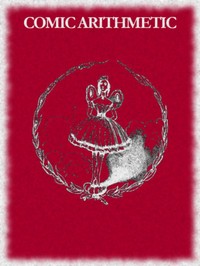
Percival Leigh's Comic Arithmetic (1844) opens with a preface that promises to make a man of the reader by teaching "practical philosophy in every chapter; wisdom in every page; and common sense in every line." The book is not a textbook but a sustained satire that borrows the structure of an arithmetic primer—complete with sections on addition, subtraction, multiplication, and evolution—to mock Victorian society. Leigh's prose shifts between mock-didactic definitions and comic verse, while Alfred Crowquill's illustrations reinforce the jokes with visual puns. The result is a work that uses mathematical terminology as a lens for social critique, targeting lawyers, debtors, lovers, and the fashionable.
Arithmetic as a Language of Satire
Leigh treats arithmetic operations as metaphors for human behavior. Subtraction becomes "taking from" in a literal sense, illustrated by a scene of a man being fleeced. Multiplication is linked to pluralism—holding multiple church livings—and division is a "cutting joke" about China. The preface declares that "the dead abstractions of this science will make a man," but the examples that follow show arithmetic as a tool for exposing greed, hypocrisy, and folly. The definitions are deliberately absurd: "Evolution comprehends all the tricks, shifts, schemes, and stratagems, by which we get out of our various difficulties." This redefinition turns a mathematical term into a commentary on legal and romantic entanglements.
Verse as a Vehicle for Critique
Several sections are written in rhyming verse, often in the form of parodies of familiar poems or nursery rhymes. The law evolution section adapts the spider-and-fly motif: "Will you walk into my office," said the lawyer, Mr. Sly, / "'Tis the prettiest little office that ever you did spy." The verse allows Leigh to compress a critique of legal predation into a memorable, almost folkloric form. The client is "fairly caught as any little fly," and the lawyer "sucked his client's blood." The verse sections are not mere decoration; they advance the satire with a rhythmic punch that prose alone would lack.
The Social Logic of Debt and Fashion
Leigh devotes considerable space to debt, treating it as a social performance rather than a financial failing. "To be involved is patriotic, fashionable, genteel, and sentimental. To pay is vulgar, inconvenient, and unpopular." He inverts conventional morality: "The man who lives within his means is never considered to have any means." The logic is that debt creates importance—"the greater the number of creditors, the greater must be the sensation produced." This is not mere cynicism but a pointed observation about Victorian status anxiety. The old proverb "Out of debt out of danger" is replaced by "In debt out of danger," with debt described as "the safest helmet."
Illustrations as Visual Puns
Alfred Crowquill's illustrations are integral to the satire, each one a visual extension of a mathematical or social concept. The list of illustrations includes titles like "The Sign of Equality—'Who are You?'" and "Dividing the Chinese, a cutting Joke." The images often literalize metaphors: a man being "taken in and done for" is shown as a fish in a net; "The Lion's Share" depicts a lion at a feast. Crowquill's style is energetic and caricatured, matching Leigh's tone. The illustrations are not merely decorative but function as punchlines, reinforcing the text's critique through visual exaggeration.
Readers approaching Comic Arithmetic should expect a hybrid work: part mock-textbook, part verse satire, part illustrated social commentary. Leigh's humor depends on recognizing the gap between arithmetic's precision and human irrationality. The book rewards attention to its wordplay and to Crowquill's visual jokes. It is best read not as a continuous narrative but as a series of comic set-pieces, each built around a mathematical conceit.
I’ve always loved how Comic Arithmetic turns sums into sly jokes about human folly. It reminds me of an older, quieter companion, The Earliest Arithmetics in English — Story, Setting & Ideas, where numbers feel like honest workmates. Both whisper of a time when counting was close to storytelling—gentle, earnest, and never in a hurry.