About 214 minutes
The Number Concept: Its Origin and Development — Reading Companion
Arithmetic · Applied Mathematics
49,160 recorded words. 7 minutes difference from this book's estimate.
View Gutenberg source #16449
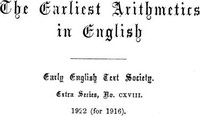
The source record for The Earliest Arithmetics in English — Story, Setting & Ideas measures this digital text at 47,458 words, 3 hr 27 min estimated reading time, and 9 detected text sections.
The text analysis averages about 20.0 words per sentence, while the detected sections provide another way to judge how the source is divided.
Project Gutenberg metadata also associates the work with “Mathematics -- History,” connecting these edition facts with the source record’s subject description.
Explore this collection
These alternatives are selected using recorded categories and estimated reading time.
About 214 minutes
Arithmetic · Applied Mathematics
49,160 recorded words. 7 minutes difference from this book's estimate.
View Gutenberg source #16449About 225 minutes
Arithmetic · Applied Mathematics
51,581 recorded words. 18 minutes difference from this book's estimate.
View Gutenberg source #22599About 108 minutes
Arithmetic
24,784 recorded words. 99 minutes difference from this book's estimate.
View Gutenberg source #46120Search stored excerpts and compare books → Choose by your preferences →
Choices use stored catalog measurements. Estimates vary with reading speed. A shared category is a catalog label, not a claim that two books have the same argument or literary quality.
Search reads excerpt text stored with this catalog and links to its associated Gutenberg record. The connection is stored in the site database; this tool does not recheck that every excerpt is word-for-word identical to that external record. Excerpt search does not cover every chapter and does not verify historical publication dates.
Catalog snapshot checked: 2026-09-26. Coverage: 35 public books, 31 available source excerpts.
Calculated from edition completeness, EPUB availability, text structure and catalogue metadata. Not a user rating.
Total of 100 points, scaled to a 2.5-5.0 range. Editions with an empty description or a missing EPUB file are not scored.
Public-domain source text
The source text is kept in the dedicated reader, separate from this catalogue record and its commentary.
Robert Steele's 1922 edition brings together five early English arithmetic texts, the earliest dating from the 14th century. The opening excerpt from 'The Crafte of Nombrynge' immediately confronts the reader with a foreign orthography: 'ȝ' for yogh, 'ſ' for long s, and the numeral '0' sometimes printed as Greek φ (phi). The editor's introduction notes that until the mid-15th century, most arithmetic was studied in Latin, and even simple division could be a challenge. This collection, then, represents a crucial shift toward vernacular mathematical instruction.
The excerpts demand careful attention to spelling and typography. In 'The Crafte of Nombrynge,' the word 'withdraw' appears inconsistently hyphenated as 'w i t h draw,' and the letter 'd' for pence sometimes has a curl. The editor preserves these features, noting that 'the first few occurrences of d were printed with a curl.' Readers must also navigate marginal notes, brackets that are original, and diagrams that may not align perfectly in all browsers. The text includes at least five types of marginal note, detailed at the end of the e-text. This is not a modernized edition; it reproduces the historical artifacts as faithfully as possible.
The excerpts show a step-by-step approach to operations like subtraction and mediation (halving). For subtraction, the text advises working from right to left, though it notes that 'me may wele fro the lift side begynne.' The proof of subtraction is to add the subtracted figures back to the original. Mediation begins at the rightmost digit: if the first figure is unity, it is written as a cipher and the unity is resolved into '60 mynvtes' (minutes), half set aside. If the figure is odd, the next even number is taken, and the remaining unity is worth 10, added to the preceding figure. These instructions mix Latin-derived terms ('vnyte,' 'cifre') with practical examples.
Duplation (doubling) is described as 'aggregacion of nombre to itself.' Unlike subtraction and mediation, duplation begins at the left side, 'of the more figure.' The text explains that if one started from the right, 'omwhile me myght double oo thynge twyes.' This attention to the order of operations reflects a pedagogical concern: the method must avoid redundant doubling. The examples use a tabular format with columns of digits, and the reader is expected to 'write and worch' until the total is doubled. The excerpts do not provide complete worked examples, but the pattern of instruction is clear.
Robert Steele's introduction frames the texts as rare survivals, noting that 'the number of English arithmetics before the sixteenth century is very small.' The editor has added an Index of Technical Terms and a Glossary, which are essential for navigating terms like 'algorism' (the Arabic numeral system) and 'cifre' (zero). The reader is advised to consult these aids when encountering unfamiliar words. The excerpts also include a 'Carmen de Algorismo' in Latin, showing the bilingual context of early arithmetic. The edition is not a narrative but a collection of primary sources; the reader must engage actively with the original forms.
This edition rewards a patient, methodical reading. Focus on the procedural language rather than the numerical results: the texts are as much about the logic of calculation as about the answers. Use the glossary and index to track terms across the different treatises. The variations in spelling and notation are not errors but evidence of a living, evolving mathematical language. Approach the work as a historical document of how arithmetic was taught and learned in medieval and early modern England.
There is a sweetness in those old English arithmetic books, watching numbers learn to speak their first hesitant grammar. That same quiet wonder follows me into The Number Concept: Its Origin and Development — Reading Companion, where the counting fingers themselves become a story. Both feel less like instruction, more like eavesdropping on the childhood of thought.
Your answers remain private and are stored only in this browser.