About 19 minutes
The Fibonacci Number Series — Context and Discussion
Arithmetic
4,212 recorded words. 7 minutes difference from this book's estimate.
View Gutenberg source #302
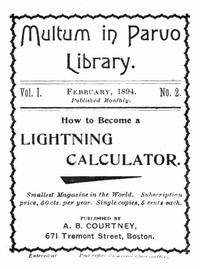
This digital edition of How to become a lightning calculator — Background and Themes is described by source-level measurements including 5,799 words, 26 min estimated reading time, and 17 detected text sections.
The text analysis averages about 17.1 words per sentence, while the detected sections provide another way to judge how the source is divided.
Project Gutenberg metadata also associates the work with “Mental arithmetic,” connecting these edition facts with the source record’s subject description.
Explore this collection
These alternatives are selected using recorded categories and estimated reading time.
About 19 minutes
Arithmetic
4,212 recorded words. 7 minutes difference from this book's estimate.
View Gutenberg source #302About 16 minutes
Arithmetic
3,562 recorded words. 10 minutes difference from this book's estimate.
View Gutenberg source #2584About 15 minutes
Arithmetic
3,373 recorded words. 11 minutes difference from this book's estimate.
View Gutenberg source #2586Search stored excerpts and compare books → Choose by your preferences →
Choices use stored catalog measurements. Estimates vary with reading speed. A shared category is a catalog label, not a claim that two books have the same argument or literary quality.
Search reads excerpt text stored with this catalog and links to its associated Gutenberg record. The connection is stored in the site database; this tool does not recheck that every excerpt is word-for-word identical to that external record. Excerpt search does not cover every chapter and does not verify historical publication dates.
Catalog snapshot checked: 2026-09-26. Coverage: 35 public books, 31 available source excerpts.
Calculated from edition completeness, EPUB availability, text structure and catalogue metadata. Not a user rating.
Total of 100 points, scaled to a 2.5-5.0 range. Editions with an empty description or a missing EPUB file are not scored.
Public-domain source text
The source text is kept in the dedicated reader, separate from this catalogue record and its commentary.
This 1894 pamphlet, issued as the second number of the Multum in Parvo Library, advertises itself as the “Smallest Magazine in the World.” Its anonymous author wastes no space: the first rule, “Accuracy should be first considered, then rapidity,” is immediately undercut by the claim that “quick adders, by the way, are the most accurate.” That tension between caution and speed runs through every page. The book teaches techniques such as adding two columns at once, a “short method” for interest, and a proof of multiplication that takes “ten seconds.” It also plugs a separate volume, W. D. Rowland’s How to become expert with figures, and includes a “Mail Directory” that promises to flood the reader with free samples and catalogues.
The manual opens with a paradox: “Accuracy should be first considered, then rapidity.” Yet the very next sentence declares that “quick adders, by the way, are the most accurate.” This contradiction is never resolved; instead, the text proceeds to advocate for methods that prioritize speed. For example, it advises the reader to “keep your thought on results not numbers themselves” and to avoid saying “7 and 4 are 11 and 8 are 19” but instead “say 7, 11, 19 and so on.” The goal is to eliminate intermediate mental steps. Similarly, when adding horizontally, the instruction is to “begin at the left,” a reversal of the usual right-to-left approach. The author seems less concerned with theoretical correctness than with practical efficiency, even if that means bending conventional wisdom.
The examples and problems in this pamphlet are overwhelmingly financial. The section on “Interest Computations” walks through calculating interest on $462.50 for one month and eighteen days at 6 percent, using a method that divides 360 (the “interest year”) by the interest rate. Other sections cover “Bank Discount,” “Equation of Payments,” and “The Canadian Interest Rule.” The emphasis is on the kind of arithmetic a clerk or merchant would perform daily. The author even includes a “Table of Transposed Numbers,” presumably to help catch errors in ledger entries. This focus on commerce is reinforced by the promotional material: the book itself is a product sold by subscription, and it offers readers a chance to have their names added to a “Mail Directory” for two years, ensuring a stream of commercial circulars.
The pamphlet’s structure blurs the line between instruction and advertisement. The title page identifies it as “Vol. I. February, 1894. Published Monthly. No. 2,” and the subscription price is 50 cents per year. Within the text, the author recommends Rowland’s book and provides ordering instructions: “You can get this handy book by sending 25 cents in stamps to American Nation Co., Boston.” The final pages include a “Mail Directory” that explains how readers will receive “sample copies of publications, circulars, catalogues, etc.” from various concerns. This commercial framing suggests that the manual’s primary purpose may have been to generate leads and sales rather than purely to educate. The reader is both student and potential customer.
Readers should approach this pamphlet as a period artifact as much as a practical guide. The methods are presented without proof or derivation, and the author’s claims about speed and accuracy are asserted rather than demonstrated. The value lies in observing how arithmetic was taught to a popular audience in the 1890s—and how that instruction was embedded in a commercial enterprise. For those interested in historical pedagogy or the self-improvement literature of the Gilded Age, this slim volume offers a revealing snapshot.
There’s something touching about that old manual’s promise of quick sums—its faith in cleverness over patience. It reminds me of flipping through The First 1001 Fibonacci Numbers — Themes and Context, where numbers also unfold like quiet secrets, not shortcuts. Both feel like a slower time, when arithmetic was a private, almost tender thing.
Use these questions to collect your thoughts before moving on.