About 333 minutes
The Way To Geometry — Edition Insights
Geometry
76,509 recorded words. 20 minutes difference from this book's estimate.
View Gutenberg source #26752
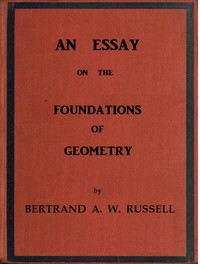
An essay on the foundations of geometry — Context and Discussion can be approached with a clearer sense of reading commitment from its source measurements: 81,173 words, 5 hr 53 min estimated reading time, and 14 detected text sections.
The text analysis averages about 23.9 words per sentence, while the detected sections provide another way to judge how the source is divided.
Project Gutenberg metadata also associates the work with “Geometry -- Foundations,” connecting these edition facts with the source record’s subject description.
Explore this collection
These alternatives are selected using recorded categories and estimated reading time.
About 333 minutes
Geometry
76,509 recorded words. 20 minutes difference from this book's estimate.
View Gutenberg source #26752About 404 minutes
Geometry
92,782 recorded words. 51 minutes difference from this book's estimate.
View Gutenberg source #21076About 221 minutes
Geometry
50,667 recorded words. 132 minutes difference from this book's estimate.
View Gutenberg source #33093Search stored excerpts and compare books → Choose by your preferences →
Choices use stored catalog measurements. Estimates vary with reading speed. A shared category is a catalog label, not a claim that two books have the same argument or literary quality.
Search reads excerpt text stored with this catalog and links to its associated Gutenberg record. The connection is stored in the site database; this tool does not recheck that every excerpt is word-for-word identical to that external record. Excerpt search does not cover every chapter and does not verify historical publication dates.
Catalog snapshot checked: 2026-09-26. Coverage: 35 public books, 31 available source excerpts.
Calculated from edition completeness, EPUB availability, text structure and catalogue metadata. Not a user rating.
Total of 100 points, scaled to a 2.5-5.0 range. Editions with an empty description or a missing EPUB file are not scored.
Public-domain source text
The source text is kept in the dedicated reader, separate from this catalogue record and its commentary.
Russell opens by framing the problem through Kant, who connected the à priori with the subjective. He distinguishes the psychological subjective from the epistemological à priori, adopting a purely logical test: what knowledge is necessary for experience to be possible? This sets the stage for a rigorous inquiry into whether geometric axioms are necessary or contingent.
The essay moves between historical exposition—drawing on Klein’s division of metageometry into three periods—and philosophical argument. Russell’s method is to isolate the logical structure of geometry from its empirical applications, using projective geometry as a bridge between pure intuition and physical space.
Russell’s central tool is a logical criterion: knowledge is à priori if without it knowledge would be impossible. He applies this to geometric axioms, asking which are necessary for any spatial experience. The test avoids psychological speculation, focusing instead on the conditions that make measurement and spatial ordering conceivable. This approach allows Russell to separate projective from metric geometry, arguing that projective properties (like straightness and incidence) are à priori, while metric ones (like distance and congruence) are empirical. The distinction hinges on whether an axiom can be denied without contradiction—a method he borrows from Kant but sharpens with modern logical tools.
Russell reconstructs Lotze’s objection to Helmholtz’s Spherelander thought experiment. Lotze claimed that a being confined to a spherical surface would find a straight line returning to its starting point an “unendurable contradiction,” forcing it to infer a third dimension. Russell counters that this contradiction exists only for a Euclidean imagination. He points out that a complete three-dimensional geometry has been developed on the assumption of finite straight lines, and that the measure of curvature can be constant without internal contradiction. The Spherelander, Russell argues, could determine his space-constant by measuring small triangles, not by traversing the whole circle. The analogy, he insists, is only an illustration, not a proof.
Russell devotes significant attention to projective geometry, which he considers the foundation of spatial knowledge. Projective properties—such as the relation of points and lines, and the concept of cross-ratio—are invariant under projection and do not depend on measurement. He argues that these properties are necessarily true for any conceivable space, because they are presupposed by the very idea of spatial order. This claim is supported by the fact that non-Euclidean geometries share projective axioms with Euclidean geometry. Russell thus isolates a common logical core that all geometries must accept, making projective geometry the true à priori element. Metric geometry, by contrast, introduces contingent elements like the parallel postulate.
Throughout the essay, Russell grapples with the relationship between the mind and space. He rejects the view that space is a mere psychological construct, instead arguing that the à priori forms of intuition are necessary conditions for objective knowledge. However, he is careful not to claim that the mind imposes arbitrary structures on reality. Instead, he suggests that the logical requirements for spatial experience are few and abstract, leaving room for empirical determination of the actual geometry of the world. This nuanced position allows him to accept non-Euclidean geometries as logically possible while maintaining that Euclidean geometry may be empirically true. The discussion reflects his debt to Kant, but also his move toward a more logical and less psychological interpretation of the à priori.
Russell’s essay is best read as a philosophical argument that proceeds by logical dissection rather than historical narrative. Readers should attend to his careful separation of projective and metric geometry, and to his use of thought experiments as limited analogies, not proofs. The work rewards those who follow his logical tests and his engagement with Kant, Helmholtz, and Lotze. It is a demanding but precise contribution to the philosophy of space.
There’s something touching about Russell’s careful mapping of what we can know about space, and how the mind shapes it before we ever measure a thing. It reminded me of Archimedes, another thinker who trusted pure thought so deeply. That old faith in reasoning feels almost like a quiet, distant friend. Archimedes — Key Ideas to Explore brings that same feeling back.
Capture what you thought, learned, and would like to remember.
![Cover of The Seven Follies of Science [2nd ed.] A popular account of the most famous scientific impossibilities and the attempts which have been made to solve them. To which is — A Reader’s Guide](https://ecazu.com/storage/media/covers/pg36547.jpg)