About 353 minutes
An essay on the foundations of geometry — Context and Discussion
Geometry
81,173 recorded words. 20 minutes difference from this book's estimate.
View Gutenberg source #52091
The catalog record for The Way To Geometry — Edition Insights provides practical reading context through 76,509 words, 5 hr 33 min estimated reading time, and 16 detected text sections.
The text analysis averages about 19.6 words per sentence, while the detected sections provide another way to judge how the source is divided.
Project Gutenberg metadata also associates the work with “Geometry -- Early works to 1800,” connecting these edition facts with the source record’s subject description.
Explore this collection
These alternatives are selected using recorded categories and estimated reading time.
About 353 minutes
Geometry
81,173 recorded words. 20 minutes difference from this book's estimate.
View Gutenberg source #52091About 404 minutes
Geometry
92,782 recorded words. 71 minutes difference from this book's estimate.
View Gutenberg source #21076About 221 minutes
Geometry
50,667 recorded words. 112 minutes difference from this book's estimate.
View Gutenberg source #33093Search stored excerpts and compare books → Choose by your preferences →
Choices use stored catalog measurements. Estimates vary with reading speed. A shared category is a catalog label, not a claim that two books have the same argument or literary quality.
Search reads excerpt text stored with this catalog and links to its associated Gutenberg record. The connection is stored in the site database; this tool does not recheck that every excerpt is word-for-word identical to that external record. Excerpt search does not cover every chapter and does not verify historical publication dates.
Catalog snapshot checked: 2026-09-26. Coverage: 35 public books, 31 available source excerpts.
Calculated from edition completeness, EPUB availability, text structure and catalogue metadata. Not a user rating.
Total of 100 points, scaled to a 2.5-5.0 range. Editions with an empty description or a missing EPUB file are not scored.
Produced by Jonathan Ingram, Keith Edkins and the Online Distributed Proofreading Team at https://www.pgdp.net
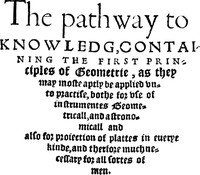
Being necessary and usefull,
Astronomers. Engineres. Geographers. Architecks. Land-meaters. Carpenters. Sea-men. Paynters. Carvers, &c.
Written by Peter Ramus
Translated by William Bedwell
Because of the heavy dependence of this book on its diagrams and illustrations, a text version was not prepared.
William Bedwell's 1636 translation of Petrus Ramus's The Way to Geometry presents geometry not as abstract theory but as a practical tool for astronomers, engineers, carpenters, and painters. The book's structure is distinctive: each concept is introduced through numbered propositions (e.g., '7 A right angle is equall to the rightangles made of one of his sides and the segments of the other'), followed by demonstrations that often invoke arithmetic examples. For instance, to explain the distributive property of multiplication, the text breaks 8 into 5 and 3, showing that 4 times 8 equals 4 times 5 plus 4 times 3. This method bridges geometric reasoning with everyday calculation.
The text organizes geometry into a series of concise, numbered statements. For example, proposition 8 states: 'If foure right lines be proportionall, the rectangle of the two middle ones, is equall to the rectangle of the two extremes.' Each proposition is followed by a demonstration and often a diagram reference (e.g., '16. p vj'). This structure allows readers to progress stepwise, with each new claim building on earlier ones. The translator Bedwell has 'much enlarged' the original Latin, adding examples and clarifications. The result is a textbook that prioritizes logical sequence over narrative, making it suitable for self-study or classroom use.
Throughout the excerpts, arithmetic examples are used to illuminate geometric concepts. When explaining that a rectangle's area equals base times height, the text gives a concrete instance: 'If the Base of a Rectangle be 6. And the height 4. The plot or content shall be 24.' It further notes that this multiplication is 'geometricall' because it produces a surface, not a line. The text also draws on arithmetic to justify geometric rules, as when it breaks 8 into 5 and 3 to demonstrate the distributive property. This interplay between number and shape would have made the material accessible to readers familiar with basic arithmetic but new to geometry.
The title page lists a wide range of intended users: 'Astronomers, Engineres, Geographers, Architecks, Land-meaters, Carpenters, Sea-men, Paynters, Carvers, &c.' The text itself reflects this practical orientation. For instance, it mentions that 'Boord, Glasse, and Paving-stone are measured by the foote: Cloth, Wainscote, Painting, Paving, and such like, by the yard.' This attention to real-world measurement suggests the book was designed for craftsmen and surveyors who needed geometric knowledge for their trades. The dedication to John Greaves, Professor of Geometry at Gresham College, further underscores the work's connection to applied mathematics.
Readers should approach this edition as a historical artifact of mathematical instruction. The numbered propositions and arithmetic analogies reward careful reading, while the practical examples offer insight into 17th-century measurement practices. Because the excerpts are incomplete, the full scope of Bedwell's enlargements and the book's later sections remain unknown. However, the consistent method—defining terms, proving properties, and linking to arithmetic—makes the work a coherent introduction to elementary geometry as it was taught in early modern England.
I keep thinking about how Bedwell’s old geometry book builds each idea slowly, step by numbered step, like laying bricks. There’s a quiet patience in that, a trust that understanding comes from handling one small piece at a time. It reminded me of something similar in Archimedes — Key Ideas to Explore, where the weight of each proof feels earned, not rushed. That lingering sense of waiting with a thought stayed with me.
Answer a few questions and save a private reflection on this device.
![Cover of The Seven Follies of Science [2nd ed.] A popular account of the most famous scientific impossibilities and the attempts which have been made to solve them. To which is — A Reader’s Guide](https://ecazu.com/storage/media/covers/pg36547.jpg)