About 89 minutes
Archimedes — Key Ideas to Explore
Geometry · Applied Mathematics
20,434 recorded words. 15 minutes difference from this book's estimate.
View Gutenberg source #35550
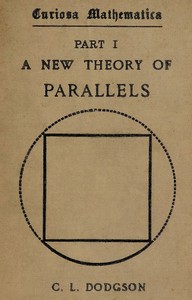
Before opening Curiosa mathematica, Part 1 — Reading Companion, the edition data offers a quick orientation: 23,903 words, 1 hr 44 min estimated reading time, and 16 detected text sections.
The text analysis averages about 18.2 words per sentence, while the detected sections provide another way to judge how the source is divided.
Project Gutenberg metadata also associates the work with “Mathematics -- Problems, exercises, etc.,” connecting these edition facts with the source record’s subject description.
Explore this collection
These alternatives are selected using recorded categories and estimated reading time.
About 89 minutes
Geometry · Applied Mathematics
20,434 recorded words. 15 minutes difference from this book's estimate.
View Gutenberg source #35550About 80 minutes
Geometry · Applied Mathematics
18,348 recorded words. 24 minutes difference from this book's estimate.
View Gutenberg source #71655About 158 minutes
Geometry
36,340 recorded words. 54 minutes difference from this book's estimate.
View Gutenberg source #22062Search stored excerpts and compare books → Choose by your preferences →
Choices use stored catalog measurements. Estimates vary with reading speed. A shared category is a catalog label, not a claim that two books have the same argument or literary quality.
Search reads excerpt text stored with this catalog and links to its associated Gutenberg record. The connection is stored in the site database; this tool does not recheck that every excerpt is word-for-word identical to that external record. Excerpt search does not cover every chapter and does not verify historical publication dates.
Catalog snapshot checked: 2026-09-26. Coverage: 35 public books, 31 available source excerpts.
Calculated from edition completeness, EPUB availability, text structure and catalogue metadata. Not a user rating.
Total of 100 points, scaled to a 2.5-5.0 range. Editions with an empty description or a missing EPUB file are not scored.
Lewis Carroll's Curiosa Mathematica, Part 1 (1895) is not a whimsical fantasy but a serious geometrical treatise that attempts to prove Euclid's parallel postulate without invoking the controversial 12th Axiom. Writing as Charles L. Dodgson, the Oxford mathematician employs a distinctive voice that mixes precise logical argument with dry humor, addressing the reader directly as 'gentle Reader' and acknowledging the 'not-wholly-solemn point of view' he sometimes adopts. The work is structured in two books: Book I contains propositions provable without any disputable axiom, while Book II relies on a new axiom involving a tetragon (replacing an earlier hexagon).
Carroll's preface reveals his awareness of the history of attempts on the parallels problem, citing Cuthbertson's Euclidean Geometry and noting that proving a triangle's angles are not less than two right angles remains an 'ignis fatuus'—a will-o'-the-wisp. The text also ventures into the nature of infinity, distinguishing between finite areas, infinities of the first order (an infinite strip), and infinities of the second order (a half-plane), and arguing that a continuously narrowing strip must pass through every finite area before reaching zero.
The chief novelty Carroll announces is the substitution of 'Tetragon' for 'Hexagon' in his axiom, a change he claims makes the figure 'more simple, and more easily constructed.' The axiom is designed to prove Euclid I.32 (the sum of angles in a triangle) without recourse to the 12th Axiom. Carroll does not state the axiom verbatim in the preface, but he emphasizes that the new figure is an improvement. This revision between editions shows his iterative approach to foundational geometry.
Carroll separates propositions into two classes: those requiring no disputable axiom (Book I) and those depending on his new axiom (Book II). He highlights that the theorem 'There is a Triangle whose angles are together not-greater than two right angles' is provable without any disputable axiom—a result he finds 'very remarkable and interesting.' The complementary theorem (not-less than two right angles) remains elusive, and Carroll wryly notes that whoever proves it 'will certainly deserve a place among the world's great discoverers.'
Carroll's discussion of infinite areas is one of the most striking passages. He imagines two parallel lines at a finite distance, forming an infinite strip. This strip, though infinite in area, is 'an Infinity of a lower order than the Infinite-Plane.' He distinguishes three kinds of area: finite (e.g., a square inch), infinities of the first order (the strip), and infinities of the second order (the upper half-plane). He argues that infinities of the same order have finite ratios to one another, so halving the strip's width halves its area—a claim that relies on the notion that two such strips laid side by side make the original.
Carroll then pushes the thought experiment to its limit: as the two lines approach coincidence, the strip's area diminishes continuously. He asserts that when the lines coincide, the area is zero. Invoking an axiom that a continuously varying magnitude passes through every intermediate value, he concludes that the strip must at some point have every conceivable finite area—for instance, exactly one square inch. This leads to a paradox: an infinite-length strip with a finite area. Carroll challenges the reader to compute its width, a problem he leaves dangling.
Carroll's mathematical writing is leavened with wit and direct address. He refers to his critics with 'no feeling of disrespect' but aims 'to lighten a subject, naturally somewhat too heavy and sombre.' He invites the reader to 'part company with me at this point' if they disagree, and uses rhetorical questions like 'Can you, oh gentle Reader, find...' to engage. This tone is unusual in a geometry treatise and reflects Carroll's dual identity as mathematician and author of children's literature.
Despite the playfulness, the arguments are tightly reasoned. Carroll carefully defines terms like 'separational' (non-intersecting lines) and distinguishes between different orders of infinity. He references M. Bertrand's axiom on equality of spaces and Euclid's own tacit assumption in Book X, Prop. 1. The preface also notes that his proof of Euclid's 12th Axiom (for finite magnitudes) is borrowed from Cuthbertson, with alterations. This blend of rigor and levity makes the work accessible to a general reader while still engaging specialists.
Readers approaching Curiosa Mathematica should be prepared for a hybrid text: part serious geometry, part intellectual game. Carroll assumes familiarity with Euclidean propositions but explains his novel concepts—like orders of infinity—in plain language. The work rewards careful attention to his definitions and axioms, as well as an appreciation for his sly humor. Those interested in the history of the parallel postulate will find a distinctive voice in the long debate, one that treats the subject with both reverence and irreverence.
I keep thinking about Carroll's gentle insistence that some truths simply ask to be accepted, not proven—how he plays with the edges of certainty without forcing a conclusion. That same patient wonderment stayed with me reading Archimedes — Key Ideas to Explore, where shapes and circles seem to whisper their own secrets. It felt less like study, more like sitting quietly beside an old friend who knows things.
A brief reflection can help important ideas stay with you longer.
![Cover of The Seven Follies of Science [2nd ed.] A popular account of the most famous scientific impossibilities and the attempts which have been made to solve them. To which is — A Reader’s Guide](https://ecazu.com/storage/media/covers/pg36547.jpg)