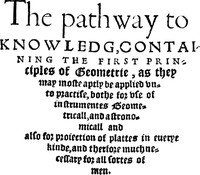
Robert Record's The Path-Way to Knowledg (1551) is the first English geometry textbook, written as a dialogue between Master and Scholar. Record deliberately omits formal demonstrations, stating he will first teach the 'sence of the propositions' and later, if readers wish, supply proofs 'with sundry varietees of demonstrations.' The book's structure—conclusions before theorems—reverses Euclid's order, a choice Record defends by arguing that in teaching 'the effect must be fyrst declared, and than the cause therof shewed.'
Record addresses his 'gentle reder' directly, acknowledging that 'straung paths ar not trodẽ al truly at the first.' He positions his work as a plain introduction for those 'not exercised in the studie of Geometrye,' hoping it will ease their later study of Theon and other commentators on Euclid.
A Dialogue of Master and Scholar
Record frames each lesson as a conversation between a Master and his Scholar, a common humanist device that allows him to anticipate and answer a beginner's questions. The Scholar often interrupts to ask for clarification or to object, and the Master patiently rephrases. For example, when the Scholar struggles with a definition, the Master says, 'I will declare it more plainly.' This back-and-forth mimics a real classroom, where Record himself taught and 'tried it to bee true' that separating meaning from proof aids comprehension.
The dialogue form also lets Record insert humor and personality. The Scholar occasionally complains, and the Master chides him gently: 'Thou muste needes be content to learne one thing after an other.' These exchanges break up the dense geometric content and give the book a lived-in feel, as if the reader is overhearing a tutorial.
The Vernacular as a Pedagogical Choice
Record explicitly defends writing geometry in English, noting that 'neuer booke was written before now, in that tungue' on this subject. He anticipates critics who might prefer Latin or Greek, and answers them by arguing that strange matters delight most men, and that the practice of geometry is 'so pleasaunt in vsinge, and so profitable in appliynge' that it deserves a wide audience.
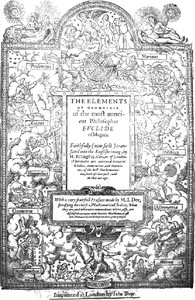
His English is deliberately plain and 'blunte,' as he calls it—a contrast to the 'exacte woorkes of Theon.' He uses colloquial phrases ('I dare presuppose'), and his spelling is phonetic and variable (e.g., 'knowledg,' 'geometrie,' 'tungue'). This roughness is part of his strategy: he wants to lower the barrier for readers who might be intimidated by scholarly Latin. The book's title page even advertises it as 'containing the first principles of geometrie' in a way that 'all fresshe fine wittes' can follow.
Ordering Knowledge: Conclusions Before Theorems
Record's most striking structural choice is placing 'Conclusions' (practical problems) before 'Theoremes' (theoretical proofs). He acknowledges that this reverses the natural order of cause and effect, but insists that in teaching, 'the effect must be fyrst declared.' A student must first learn that something works, then what it means, and only later why it is true.
He cites precedents: Boethius and Georgius Joachim Rheticus both published Euclid without demonstrations. Record even promises that if his method proves welcome, he will later issue a full edition 'with sundry varietees of demonstrations.' This provisional, modular approach suggests he saw the Path-Way as a first course, not a definitive text. The four-book structure—definitions, theorems, constructions, measurement—mirrors this progressive design.
The Material Book: Figures, Signatures, and Typography
The original 1551 edition was printed in blackletter type, with geometric diagrams cut into woodblocks. Record laments the 'charges in cuttyng of the figures' as one reason he did not publish all of Euclid at once. The e-text preserves the original signature marks (A.i., A.ij., etc.) and adds bracketed page numbers for verso pages, since the printed book had none.
Typography is a clue to the book's audience: sans-serif type in the e-text signals blackletter in the original, a font associated with vernacular works rather than learned Latin tomes. The text also includes Greek quotations in the introduction, transliterated in the e-text, showing Record's humanist learning even as he writes for beginners. These material details—the cost of figures, the choice of type, the signature system—reveal the practical constraints on early mathematical publishing.
Record's Path-Way rewards attention to its authorial voice: the patient Master, the defensive preface, the deliberate ordering of content. Readers should note that the e-text preserves original spelling and typographical errors (marked with popups), and that the book's structure—conclusions before theorems—is not a mistake but a pedagogical experiment. For those interested in Tudor education or the history of mathematical writing, this is a rare primary document of how one teacher tried to make Euclid speak English.
I’ve often lingered over Robert Record’s plain-spoken geometry, his gentle Tudor dialogue coaxing beginners toward Euclid without proof. Years later, I found a quieter echo in An essay on the foundations of geometry — Context and Discussion—not the same voice, but the same patient humility before first principles. They sit together in my memory now, two old friends sharing a candle.

![Cover of The Seven Follies of Science [2nd ed.] A popular account of the most famous scientific impossibilities and the attempts which have been made to solve them. To which is — A Reader’s Guide](https://ecazu.com/storage/media/covers/pg36547.jpg)